
Congress Name: 10th World Archaeological Congress (WAC-10)
Dates: 22-28 June 2025
Host Organisations: World Archaeological Congress, Flinders University and Charles Darwin University's Northern Institute
Number of delegates: 2000+ delegates (50% International)
Delegate origin: From throughout Australia and over 80 countries
NT location: Darwin, Northern Territory (NT), Australia
Congress venue: Charles Darwin University - Danala Education and Community Precinct, Darwin City
Event Overview
The 10th World Archaeological Congress (WAC-10) was staged in Darwin in Australia’s Northern Territory (NT) in June 2025 and was hosted by Flinders University in partnership with the Northern Institute at Charles Darwin University. It was the first time the Congress had ever been held in Australia.
The World Archaeological Congress (WAC) was founded in 1985 and is a non-government, not-for-profit membership organisation which provides a forum for those concerned with the study of the past. The Darwin congress brought together archaeologists, heritage professionals, anthropologists, historians and Indigenous leaders from across the globe for a week of knowledge sharing, cultural exchange and global collaboration.
WAC stages an international congress every four years with the most recent ones held in The Czech Republic, Japan, Jordan, Ireland and the United States of America. The congresses seek to provide professional training and public education, including for disadvantaged nations, groups and communities. They aim to empower and support Indigenous groups and First Nations Peoples and also offer scope for discussion on archaeological research, policy, practice and politics.
The Northern Territory was selected as the host destination for WAC-10 as a result of a bid prepared for Flinders University by the NT Government’s official convention bureau, Northern Territory Business Events. As part of the bid process, Charles Darwin University’s Northern Institute was identified as a supportive NT host partner for the congress.
Highlighting the significant cultural links, the official Congress logo depicted a mangrove tree and was designed by Darwin artist June Mills, aka Gudbiling Gunuckinimul, a Larrakia Elder and artist. The Larrakia are Traditional Custodians of the greater Darwin region and refer to themselves as Saltwater People, with the mangrove tree playing an important role in the Larrakia Dreaming story.
Why Darwin and the Northern Territory were selected as the the host destination
The Northern Territory’s strong connection to the world’s oldest living culture and the destination’s capacity to offer an array of significant archaeological and cultural heritage sites such as ancient rock art locations in World Heritage-listed Kakadu National Park, provided impetus for Darwin’s selection. The attractive climate and strategic location in northern Australia offering direct aviation access to Asia and beyond, were also factors.
It was also considered relevant that the NT offers a demonstrable commitment to Indigenous-led research and storytelling, with institutions such as Charles Darwin University and Flinders University having strong partnerships with Traditional Owners and being leaders in community-based archaeological research.
The Congress Program
The Academic sessions were held at the Charles Darwin University’s city campus Danala which is located in the Darwin Central Business District. WAC-10 also offered the option of virtual attendance, making the event accessible to those unable to attend in person.
The majority of accommodation options were within walking distance of congress venues and included globally-branded hotels and apartments which suited a range of budgets.
The diverse academic program featured plenary and general sessions, academic workshops, forums, keynote panel discussions and online poster presentations addressing all forms of archaeology - preeminent global scholars participated as panellists and keynote speakers. WAC-10 featured a total of 175 sessions focussed on 26 different themes, with 20 sessions running concurrently.
A screening of award-winning film “Ten Canoes” was staged at Darwin’s iconic outdoor Deckchair Cinema, which is located on the Darwin Harbour foreshore. The screening included a special appearance by the film’s co-directors, Rolf de Heer and Peter Djigirr. “Ten Canoes” was filmed in north-eastern Arnhem Land in the Northern Territory and was shot entirely in the Aboriginal language of the region, providing rich insights into Australian Indigenous lifestyle and culture.
Highlighting the diversity and inclusivity of the Congress, a cultural festival ran parallel to the WAC-10 academic program. It showcased the diversity and richness of Indigenous cultures from various nations and featured visual and performing arts. Aboriginal Elders, teachers and artists also shared their stories, artworks and ancient traditions, which span more than 65,000 years.
The Creative Works & Exhibitions ran for the duration of the Congress and were staged at the Danala Campus Studios. Practitioners and artists offered interactive workshops, static displays and dynamic exhibitions to share their knowledge, skills and culture, with activities both scheduled and ad hoc.
A series of bespoke one-day scientific tours to UNESCO World Heritage Listed Kakadu National Park were offered mid-congress, enabling WAC-10 delegates to visit locations such as Nourlangie, Cooinda and Ubirr. These tours provided an opportunity to engage with places of archaeological and cultural significance, with the tours guided by scientists and Traditional Custodians.
Free walking tours around Darwin escorted by local heritage and archaeology experts as well as Traditional Custodians were also offered during the Congress.
Congress Social Program
The WAC-10 Opening Night Reception was staged at the NT’s premier cultural facility, the Museum and Art Gallery of the Northern Territory (MAGNT) which is located on the fringe of the city. WAC-10 coincided with the staging of the Annual Telstra National Aboriginal and Torres Strait Islander Art Awards at the Gallery, with delegates enjoying a bonus viewing of these artworks which are part of Australia’s longest running Indigenous art awards. The Gallery also hosted fascinating behind-the-scenes tours throughout WAC-10.
An Indigenous Participants Reception was held at Government House, hosted by His Honour Professor the Honourable Hugh Heggie AO PSM, Administrator of the Northern Territory. Built in 1879, Government House is one of the Northern Territory’s most significant heritage buildings. With its tropical gardens, elegant interiors, and iconic tiled terrace, it provided a fitting backdrop for the meaningful gathering, celebrating the contributions of Indigenous delegates to the congress.
The Gala WAC-10 Awards Dinner for over 1200 guests was held outdoors on the Darwin Esplanade in the extensive parkland gardens overlooking the harbour. The event featured performances by The Youth Mill Performing Arts Co, whilst catering was provided by the nearby DoubleTree by Hilton Hotel Esplanade Darwin.
An informal congress dinner event was also held at Mindil Beach Sunset Market, located just minutes from the city centre. Delegates were able to use their allocation of ‘Mindil Money’ as they strolled amongst more than 200 speciality stalls featuring multicultural cuisine, art crafts and entertainment, while also admiring a breathtaking over-water sunset for which Darwin is justifiably renowned.
The Congress Farewell event for 986 guests was held at the award-winning Wharf One Food & Wine restaurant at the Darwin Waterfront Precinct.
Legacies and Community Engagement
As part of its focus to provide professional training and public education including for disadvantaged nations, groups and communities, WAC-10 developed a crowd-funding program to support attendance at the Congress for 20 women who were at an early stage of their careers.
One of the legacies arising from WAC-10 was the formation of a group to be known as ‘Women In Archaeology’. The official launch of the Barunga Aboriginal Knowledge Centre (BAKC) was another legacy, with the launch itself being a session within the congress. BAKC aims to provide a platform for Aboriginal people to earn income by teaching cultural protocols and conducting research on Aboriginal society and culture, whilst still residing in their own communities.
Destination Support from the NT
Northern Territory Business Events (NTBE) presented a compelling bid to attract WAC-10 to the NT. It also supported site visits to the NT by the congress organisers and provided marketing materials to assist with delegate boosting promotions aimed at maximising attendance at the Congress.
Organisers indicated they were also impressed by the contribution made by NTBE’s industry partners, who enthusiastically supported planning, preparation and delivery of the congress event.
WAC-10 Academic Secretary Professor Claire Smith AO noted that NTBE’s support was critical in providing invaluable introductions to local suppliers and also to the Federal Government’s International Event Co-ordinator Network (IECN) to assist with delegate visa applications. The IECN is part of the Australian Government’s Department of Home Affairs and assists in facilitating the smooth entry of international delegates attending business events in Australia.
Strong support was also delivered by Tourism Top End (TTE), a not-for-profit, membership-based regional tourism organisation encompassing Darwin and surrounds, World Heritage-listed Kakadu and Litchfield National Parks, remote Arnhem Land and the Katherine region. TTE provided a website landing page specifically for the Congress, including pre and post touring offers.
Pre and Post Touring undertaken in the NT
Pre and post congress touring and activity options in Darwin, the surrounding region and beyond enabled delegates to enjoy unique NT tourism experiences. These included options such as cruising on Darwin Harbour, visiting stunning Nitmiluk (Katherine) Gorge, Arnhem Land, Kakadu and Litchfield National Parks and enjoying stays in NT outback lodges. Many delegates took up these touring options with their extended stays in the NT ranging from two days to one week and longer.
In their words
Organisers stated that Darwin and the NT were critical to the success of WAC-10, with delegates able to make a meaningful connection to culture, gaining access to the living and ancient heritage. It was stated that such a successful Congress outcome could not have been achieved in any other city in Australia.
The WAC-10 Academic Secretary Professor Claire Smith AO said Flinders University was honoured to host the conference in partnership with Charles Darwin University’s Northern Institute, in the culturally-rich Darwin. Accolades from Congress organisers, sponsors and delegates included:
From the organising team:
“I don’t think Darwin can be beaten as an international congress city. With 50% of our delegates coming from overseas, Darwin was a great destination in terms of air access. The direct flights from Singapore took just over four hours, with connections from the UK, Middle East, Africa, America and beyond.”
“For Flinders University, the NT holds a special place in our archaeology teaching and research. For over 30 years our researchers have been helping to uncover the region’s deep and diverse stories – a commitment that continues to this day. I think the delegate takeaway from WAC-10 will be the vibrancy of the NT, the relaxed friendliness and the community. The Aboriginal culture is so accessible to people in the NT.”
Professor Claire Smith AO,
WAC-10 Academic Secretary & Professor of Archaeology, Flinders University
“We’re proud to have played a role in bringing WAC-10 to our shores, as this global event shines a spotlight on our stories, landscapes, and people. A major highlight was showcasing the NT’s abundant and very visible Aboriginal heritage which added authenticity and depth to the conference. The strong collaboration between local tourism operators, community partners and organisation teams ensured a smooth and memorable experience.”
Samantha Bennett,
General Manager, Tourism Top End
From WAC-10 delegates:
“The coming together of archaeologists from around the world is really very special. Personally, I've found the Indigenous component really enlightening. With support of Indigenous communities, it just highlights the way forward for archaeology - of people working together, of community, of us thinking about the future and the role that archaeology can play. I think it's a fantastic location to actually highlight those themes.”
Professor Karina Croucher
Professor of Archaeology, Heritage and Wellbeing,
University of Bradford, UK
“I love how connected Darwin is with the local culture. It’s not like big cities where everything nearly almost always feels the same. My favourite part was being able to explore Kakadu. It was amazing seeing the artwork and even more amazing to see the living stakeholders of these important archaeological sites, still here today.”
Ruben Claro “Kim” Reyes IV
Graduate & Researcher
University of the Philippines School of Archaeology
“Darwin is beautiful. It’s an experience I won’t forget in a hurry. I would one hundred percent recommend Darwin as a destination for international conferences.”
Chiamaka Lauretta Mangut
PhD Student, Department of Earth and Environmental Sciences
Columbia University, New York
From the venue and supporting host organisation:
“We were very involved in co-producing WAC-10 and provided the facility for it at our Danala campus in the city. Charles Darwin University is a comprehensive university and has a very wide base of academic disciplines including involvement with archaeology and particularly First Nations archaeology. One of the things we’re most proud of is our connection with First Nations People throughout the Northern Territory – we work on many projects together and also support those projects led by First Nations People."
Professor Scott Bowman AO,
(Former) Vice Chancellor and President
Charles Darwin University
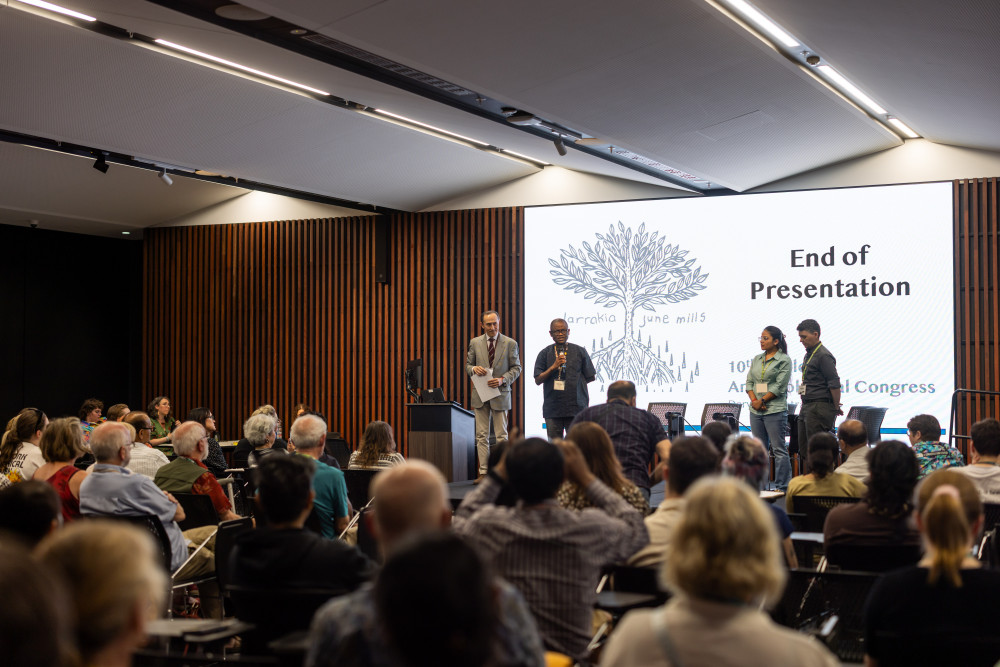
WAC-10 Endnote Address at the Charles Darwin University's Danala Campus